

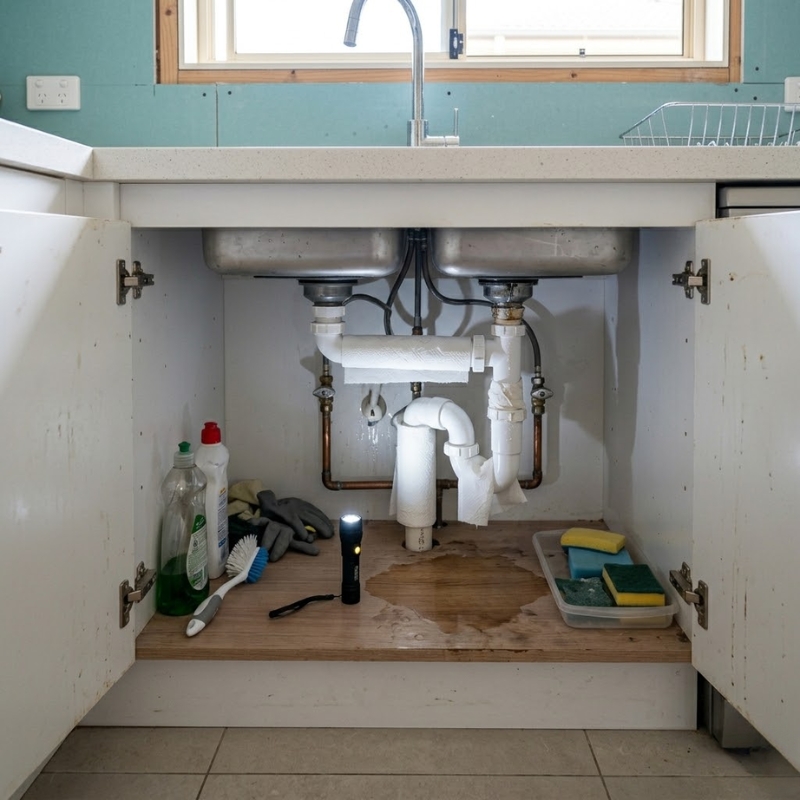
Finding moisture under the kitchen sink can feel like a minor annoyance—until cabinet bases swell, kickboards warp, or a musty smell won’t go away. In Sydney homes and apartments, under-sink leaks are especially common because this cupboard often hosts multiple failure points at once: the sink waste, trap, mixer connections, isolating valves, dishwasher hoses, and sometimes a water filter or instant hot system.
The good news is you don’t need to guess. With a few simple checks, you can usually work out whether you’re dealing with:
• a live plumbing leak (active water escaping from a fitting/pipe),
• condensation (moisture forming on cold pipes), or
• water damage from past leaks/spills that’s now showing up as swelling, mould, or delamination.
This guide walks you through what to do first, how to test, what the signs mean, and what to document—especially if you’re in an apartment and may need to notify strata.
What to do in the first 5 minutes
Before you diagnose anything, prevent the “small wet patch” from becoming a larger issue.
• Protect power first: If there’s a power point, appliance plug, or extension lead inside the cupboard, keep it dry and avoid touching wet electrical items.
• Stop the water source if needed: If water is actively running or pooling quickly, turn off the under-sink isolating valves (hot and cold). If you can’t stop it there, turn off the main.
• Contain and dry: Mop up standing water, place towels, and remove stored items so you can see the cabinet base clearly.
• Take quick photos: Even a few phone pics right away can be useful later (especially for apartments/strata or warranties).
Q&A: Should I turn off the main water straight away?
If water is actively flowing and you can’t quickly stop it at the under-sink valves, yes—turn off the main. If it’s only damp with no obvious active leak, you can usually start with the isolating valves and testing.
Plumbing leak vs condensation vs water damage: the fast “triage”
Use this simple sorting step before you do deeper checks.
More likely a plumbing leak
• Water appears even in dry weather and when nobody’s using the sink
• You can see droplets forming on a fitting, valve, or pipe joint
• The cupboard base is wet in a specific spot, not evenly damp
• There’s green/blue staining (slow seep at copper/brass fittings) or rust marks
More likely condensation (“sweating” pipes)
• Moisture appears on cold-water lines on humid days
• The dampness is more “overall” (thin film), not a single drip point
• It’s worse when you run cold water or the dishwasher uses cold fill
• The cupboard may smell musty, but there’s no obvious leak trail
More likely water damage from earlier events
• The base looks swollen, soft, or delaminated even when it’s currently dry
• You find old tide marks, warped kickboards, or swollen cabinet edges
• Mould persists despite drying because the materials stayed damp for too long
Step-by-step: how to find an under-sink leak
The goal is to identify where water is coming from, when it happens, and how fast it’s spreading.
Step 1: Dry everything and start clean
• Wipe the cabinet base dry
• Wipe all visible pipes, valves, and the underside of the sink dry
• Remove cleaning bottles/mats that can hide moisture
Pro tip: Line the cabinet base with dry paper towels (or sheets of newspaper). They make fresh drips easy to spot.
Step 2: Do the “paper towel wrap” test (5 minutes)
Wrap a dry paper towel around these common leak points:
• Hot and cold isolating valves
• Flex hoses up to the mixer
• The waste connection under the sink bowl
• The trap (P-trap or S-trap) joints and slip nuts
• Dishwasher inlet/outlet hose connections (if present)
Wait 5 minutes without using any water. If a towel gets wet, you’ve found an active seep.
Step 3: Run water in stages (10 minutes total)
Run tests in this order, checking your paper towels after each:
- Cold water for 60–90 seconds
- Hot water for 60–90 seconds
- Fill the sink halfway, then release the plug (this tests waste flow under load)
- If you have a dishwasher, run a short rinse cycle and watch the hose connections
What you’re looking for:
• Leaks that only happen during drainage (waste/trap issue)
• Leaks that happen during supply (valves/flex hose issue)
• Leaks that happen during appliance cycles (dishwasher hose or drain loop issue)
Step 4: Check the sink rim and benchtop joins
Sometimes the cupboard isn’t wet because of plumbing at all.
Look for:
• Water tracking from the benchtop edge into the cupboard
• A loose mixer base, letting water run down behind the sink
• Gaps in the sealant where splashes can enter
Q&A: Why is the cupboard under my sink wet, but I can’t see a leak?
Common reasons include a slow seep that only happens under certain conditions (hot water use, drainage under load, dishwasher cycle), or water tracking in from above (around the sink rim/mixer). Dry-and-test in stages usually reveals it.
What are the most common under-sink leak signs usually mean
A wet patch directly under the trap
Often points to:
• Loose slip nuts
• A misaligned trap connection
• A cracked trap component
• A failing washer/seal
This is especially likely if it becomes wetter after you drain a full sink.
Dampness around isolating valves or flex hoses
Often points to:
• Minor seep at valve packing or compression fittings
• Aging braided flex hoses
• Tiny pinhole leaks (hard to see until you use a paper towel)
If you see corrosion, staining, or consistent dampness, treat it seriously—these parts can fail suddenly.
Water appears only after the dishwasher runs
Often points to:
• Loose inlet/outlet hose clamp
• Drain hose backing up or leaking under pressure
• Water escaping behind cabinetry and reappearing later
Musty smell and mould, but no obvious dripping
This can be:
• Condensation combined with poor airflow
• Old water damage that never fully dried
• A slow leak that’s evaporating before it puddles
Q&A: Is mould under the sink dangerous?
It can be, especially for people with asthma or sensitivities. More importantly, mould suggests materials have been damp long enough to support growth, so the real priority is eliminating the moisture source and drying thoroughly.
How to tell condensation from an actual leak
Condensation (“pipe sweating”) is common in Sydney when the humidity is high and cold water runs through pipes.
Condensation clues
• Moisture beads evenly along the cold line
• The underside of the benchtop feels cool and slightly damp
• Dampness increases after using cold water, then reduces later
• There’s no single drip point on a fitting
Quick condensation test
- Dry the cold pipe fully.
- Run cold water for 60–90 seconds.
- Watch the pipe surface: if a thin film forms broadly, that’s condensation.
If condensation is the issue, improving airflow and insulating cold lines can help—but don’t assume it’s condensation until you’ve ruled out slow fitting leaks.
Early cabinet damage indicators you shouldn’t ignore
Even small repeated wetting can permanently damage cabinetry.
Look for:
• Swelling along the cabinet base panel seams
• Delamination (laminate lifting or bubbling)
• Soft spots you can press with a finger
• A kickboard that bows outward or won’t clip back properly
• Persistent odour even after drying
If you’re noticing these, it’s worth learning the broader signs of water damage under a kitchen sink before it spreads into adjacent cabinetry or flooring.
Q&A: How long does it take for water damage to show?
Cabinet swelling can happen quickly (sometimes within days) if materials are repeatedly soaked. Flooring and wall damage may take longer to become visible, which is why early action matters.
A 72-hour plan to confirm the source (without guesswork)
If the leak isn’t obvious, use a simple monitoring plan.
Day 1: Map moisture
• Dry everything completely
• Place paper towels on the base and wrap key joints
• Note whether the wetness appears without use or only after use
Day 2: Isolate by shutting valves
• Turn off the under-sink isolating valves overnight (if practical)
• If the cupboard stays dry, the issue is likely related to pressurised supply or usage
• If it still gets wet, look harder for tracking from above, drainage, or another nearby source
Day 3: Stress-test the likely culprit
• Repeat staged tests (cold/hot/drain/dishwasher)
• Compare wet patterns with your Day 1 photos
• If the wet area is expanding, escalate to a licensed plumber promptly
Apartment and strata: what to document in Sydney
If you’re in an apartment, under-sink water issues can affect other lots or common areas—especially if water reaches walls, slab edges, or service penetrations.
Document:
• Wide shots showing the kitchen location
• Close-ups of wet areas, fittings, and any visible corrosion
• A short note: when you first noticed it, what was running (sink/dishwasher), and how quickly it returned
• Any signs beyond the cupboard: skirting swelling, floor cupping, damp smells
This is also where credible guidance on leak detection is helpful in explaining the issue. Sydney Water’s overview on identifying leaks is a useful reference point: leak detection guidance.
Q&A: Should I report to strata if it’s “just under my sink”?
If it’s contained and clearly within your lot, you may handle it directly. But if there’s any chance it’s affecting walls, floors, service penetrations, or other lots—or you’re unsure—early reporting (with photos) usually prevents bigger disputes later.
Preventing repeats once the leak is fixed
Once you’ve fixed the cause (whether that’s plumbing repair, replacing a hose, or resealing around the sink), focus on reducing future risk:
• Keep the cupboard base clear so you can spot moisture quickly
• Avoid storing absorbent items (paper towels, cardboard) directly on the base
• Check flex hoses and valves periodically (especially in older kitchens)
• Don’t rely on silicone as the “fix” for a plumbing leak
• Make sure dishwashers and washing machines have hoses routed correctly and not kinked
For homeowners who want to think bigger than a single cupboard and reduce wet-area risks across kitchens and laundries, this is a helpful next step: preventing water damage in kitchens and laundries.
When to call a licensed plumber (or escalate)
Call a licensed plumber sooner if:
• Water is actively pooling, or you can’t stop it at isolating valves
• You see corrosion, cracking, or bulging hoses
• The leak returns after “tightening” fittings
• You suspect water has reached the flooring, walls, or electrical areas
• There’s mould or odour that persists despite drying
• You’re in an apartment, and there’s no risk to neighbouring lots
Q&A: Can I just tighten a fitting myself?
Sometimes a loose slip nut on a trap can be gently tightened, but over-tightening can crack plastic fittings or damage seals. If you’re unsure, or if the leak involves pressurised supply lines, it’s safer to have it assessed properly.
Final FAQ
Why is there water under my sink after heavy use but not otherwise?
That often points to a drainage-side issue (waste connection or trap) that leaks only when water is flowing out under load.
Could my dishwasher be leaking even if the floor looks dry?
Yes. Small hose leaks can stay inside cabinetry and show up as cabinet swelling or dampness under the sink rather than obvious floor puddles.
If the cupboard dried out, is the problem gone?
Not necessarily. If the cause remains (slow seep, condensation, tracking from the sink rim), it will return. Monitoring for over 72 hours is a reliable way to confirm.
What’s the quickest way to pinpoint the leak source?
Dry everything, wrap joints with a paper towel, then run staged tests (cold/hot/drain/dishwasher). The first towel to get wet usually identifies the culprit area.
What’s the risk if I ignore a small under-sink leak?
Cabinet bases can swell and delaminate, mould can develop, and water can spread into flooring or walls—especially if it happens repeatedly.
